
The Yellow Brick Road: A Map of the Soul’s Awakening
Maryann Miller, Msc.D.
Part I of a Series on the Wizard of Oz Movie, including Meditation
A Series Introduction
 Most of us encountered The Wizard of Oz as children, which means we encountered it before we had the capacity to understand what we were actually receiving. We watched it as a fairy tale, a colorful adventure, and a story about a girl who wanted to go home. We laughed at the Scarecrow and felt afraid of the witch and cheered when the curtain was pulled back. And then we grew up, and the film became a memory, a piece of nostalgia from our childhood, It was charming and familiar and safely behind us.
But some stories do not stay behind. Some stories are structured at a level so much deeper than their surface that they follow you forward through the years, surfacing at unexpected moments, speaking to you differently at forty than they did at seven, revealing new layers at every threshold of your own becoming. The Wizard of Oz is one of those stories. It has followed humanity forward because it is not actually a children’s story at all. It never was. It is one of the most precise and most luminous maps of the human soul’s journey toward wholeness that has ever been encoded in popular form. And like all genuine maps, it reveals more of itself the further along your own road you have traveled.
The Man Behind The Story
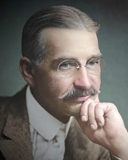 It is not accidental that this particular story carries this particular depth. L. Frank Baum, who wrote the original novel in 1900, was deeply immersed in the Theosophical tradition, the metaphysical movement founded by Helena Blavatsky, in the late nineteenth century, that sought to synthesize the esoteric wisdom of Eastern and Western spiritual traditions (that the IFGT call the Ageless Wisdom) into a unified understanding of consciousness, the soul, and the nature of reality. Baum’s mother-in-law, Matilda Joslyn Gage, was herself a prominent Theosophist and a significant influence on his thinking. The teachings of Theosophy, including the evolution of consciousness, the threefold nature of the human being, the existence of higher planes of reality, and the ultimate destiny of the soul to return to its divine source, are woven into the fabric of the Oz story so thoroughly that the esoteric reading is not a creative reinterpretation imposed from outside. It is the original architecture of the work, present from the very first page.
When you read the story through this lens, everything changes. The tornado is no longer merely a plot device. The yellow brick road is no longer merely a path. The companions Dorothy meets are no longer merely characters, and Dorothy herself is no longer merely a lost child trying to find her way home. Dorothy becomes what she always was beneath the surface of the story: a soul in the midst of its most essential and most ancient journey. The journey from unconsciousness to consciousness, from the false self to the true self, from the gray world of inherited pattern and conditioned sleep to the vivid, sometimes terrifying, but magnificent aliveness of a life fully and consciously inhabited.
What This Series Is About
This series of articles is an invitation to walk the yellow brick road as if for the first time, with the eyes of someone who suspects, perhaps has always suspected, that the story is about you. Not you in the abstract, universal sense that all great stories are about everyone, but you specifically. It’s about your tornado, your companions, your shadow, your wizard, your particular version of Kansas, your particular shade of Oz, and the specific quality of Light that lives in the ruby slippers on your own feet.
Each part of this series will take one element of the story and open it fully, exploring its esoteric meaning, its psychological resonance, its spiritual teaching, and most importantly its direct relevance to the lived experience of a soul in the midst of an awakening. We’ll move through the story in sequence, beginning with the tornado, that great initiatory disruption that sets every genuine spiritual journey in motion, and moving through each of the companions and their corresponding aspects of the human soul, through the shadow and the false authority and the long golden road of the path itself, all the way to the moment Dorothy closes her eyes, presses her heels together, and speaks the words that are simultaneously the simplest and the most profound in the entire story. There is no place like home.
Each part of this series will explore a different aspect of the soul’s journey as revealed through the timeless allegory of The Wizard of Oz. At its core, the story follows the archetypal Hero’s Journey as described by Joseph Campbell. Dorothy represents the Soul, its incarnation into the material world of Kansas, longing to return to its true divine Home. The tornado is the initiatory force, the disruption of ordinary consciousness that launches the soul onto its spiritual path, and every character, every obstacle, and every moment of grace that follows is a reflection of something deeply, unmistakably alive within each of us: The Yellow Brick Road, The Path of Illumination
The Yellow Brick Road
This is widely interpreted as the path of spiritual initiation, paved in gold, the alchemical color of solar consciousness and enlightenment. Gold in esoteric tradition represents the purified self, the highest vibrational frequency of the human spirit. To walk it is to commit to the inner journey.
Dorothy’s Three Companions, The Threefold Nature of Man
The three companions Dorothy meets represent the three aspects of the human being:
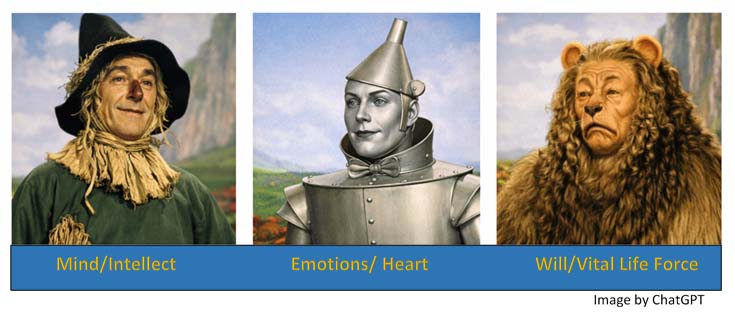
The Scarecrow (Mind/Intellect)
The Scarecrow seeks a brain, yet demonstrates wisdom throughout the journey. He symbolizes the mental body that already possesses intelligence but lacks the confidence to trust it. Esoterically, this reflects the lower mind awakening to its own divine capacity. In Theosophy, Jungian psychology, and Rosicrucian philosophy, the lower mind is precisely the faculty that doubts its own capacity. The Scarecrow’s paradox of seeking a brain, while demonstrating clever reasoning, is a perfect illustration of the mind that knows but doesn’t know that it knows. This is a classic in wisdom traditions.
The Tin Man (Emotions/Heart)
The Tin Man seeks a heart, yet weeps and feels deeply. He represents the emotional or astral body, which is the seat of compassion, love, and feeling. His rusting symbolizes the hardening of the heart through pain and disconnection from feelings. The Tin Man as the Emotional/Astral Body is deeply consistent with esoteric anatomy. The astral body in Theosophical and Rosicrucian teachings is the seat of feeling and desire. Rust as a metaphor for emotional hardening through grief and trauma is remarkably precise because it suggests a once-flowing feeling nature that became frozen through wounding.
The Cowardly Lion (Will/Vital Life Force)
The Cowardly Lion represents the will body or vital life force. His paradox is perhaps the most spiritually significant of all. Though he seeks courage, he is instinctively brave when it truly matters, reflecting the soul that possesses great inner strength but has yet to consciously claim it. The lion is a near universal symbol across traditions, embodying solar power, prana, kundalini energy, and the awakened will that make him a perfect archetype for this role. In many esoteric schools, the awakening of the will is considered the final and most critical threshold before initiation. It is the point at which seekers stops waiting for permission and step fully into their own divine authority.
Together, these three mirror the ancient Hermetic teaching: To Know, To Will, To Dare, To Keep Silent.
The Rainbow: The Bridge Between Worlds
Dorothy sings of a place somewhere over the rainbow, a direct reference to the Antahkarana in Hindu, Theosophical, and Alice Bailey teachings. The rainbow bridge connects the lower self to the Higher Self or Soul.
The Wizard, The False God / Ego Mind
The Great and Powerful Oz represents the false authority, the ego. He is loud, imposing, and fear-inducing, yet behind the curtain he is a small, ordinary man, which is a powerful metaphor for how the ego and external power structures operate. He cannot give what the companions seek because those gifts were never his to give.
The Ruby/Silver Slippers, Grounded Divine Power
In L. Frank Baum’s original novel, the slippers are silver, the color of the moon, intuition, and feminine wisdom. They represent the power that was always within the individual. The Wicked Witch’s desperate pursuit of them reflects the forces of lower consciousness attempting to steal the soul’s innate divine authority.
The iconic line, You’ve always had the power, my dear, is perhaps the most direct esoteric transmission in the entire story.
Kansas: The Return to Embodied Presence
There’s no place like home is not a call to retreat into the familiar or the unconscious. It’s a profound recognition that the Divine is not found somewhere out there, but woven into the fabric of ordinary existence. Home, in this deeper sense, represents integrated consciousness: the soul fully embodied, grounded in the Earth, and illuminated from within. It is the state in which the spiritual and the material are no longer separate, but unified. This is the completion of the alchemical Great Work, expressed in the ancient Hermetic axiom: As Above, So Below, which is realized within the soul and is reflected in the world around us.
A Closing Meditation
Each part of the series will close with a personal meditation, an invitation to take the wisdom out of the realm of the intellectual and into the lived reality of your own body, your own breath, and your own inner landscape. The Wizard of Oz, understood esoterically, is not a philosophy to be comprehended, it’s an experience to be entered into. And the entering happens not in the mind but in the quiet, courageous, fully present interior of your being who is willing to see yourself clearly and to keep walking your journey.
Who This Is For
This series is for those who have sensed that the great disruptions of their life may not have been random. For those who have stood at a crossroads and felt, beneath the fear and the uncertainty, the unmistakable quality of something larger moving through their life, with purpose. It is for those who are tired of the gray of Kansas but have not yet found the door that opens into color. It’s also for those who have been in Oz for years and are only now beginning to understand the map they have been walking.
It’s also for the seeker and the skeptic, the newly awakened and those long-walking their journeys, the ones who come to these ideas through the doorway of psychology and those who come through the doorway of prayer and those who are not sure which doorway they came through but know with absolute certainty that they are on a road that means something.
It is, in the end, for anyone who has ever looked at the familiar in their own life and felt, in the quietest and most honest chamber of themselves, that there is something more. Something truer, something that the tornado, however devastating it may have been, was always trying to help them move toward.
In Summary
The Wizard of Oz is, at its deepest level, is a story about the soul’s journey through the planes of existence, the reclamation of its threefold nature (intellect, emotions, will), the dismantling of false external authority, and the ultimate realization that divine power, wisdom, and love are not destinations, they are the truth of who we already are.
This series will ask that you to bring your own life’s experience to them, to let the story touch the places in you that recognize it. And to sit with the reflections not as intellectual exercises but as genuine inquiries into the actual living truth of your own experience. You may find that some sections move you unexpectedly. You may find that a single sentence lands with a weight that seems disproportionate to its length, which is often the sign that it has touched something true within you. I suggest that you follow those moments, sit with them for a moment, and perhaps write about them, if writing is your practice. You might also wish to breathe into them, if breath is your mechanism, or take them into the meditations at the end of each article and let your body do what the mind alone cannot.
The yellow brick road, in its deepest meaning, is not a route to be traveled efficiently. It is a path to be walked consciously, which means slowly, with full attention, and with the willingness to be changed by what you encounter along the way.
You are already journeying on the yellow brick road. You have been on it longer than you may know.
This series is simply an invitation to look, to notice the gold beneath your feet, and to recognize, perhaps for the first time with the full weight of your own understanding, exactly where you are walking and why.
Your tornado has already come, the door is already open, and the road stretches out ahead in every direction that matters.
Welcome to Oz.