
The Wizard of Oz, the Tornado, and Your Moment of Awakening
Part II in a Series on Your Soul’s Journey
Maryann Miller, Msc.D.
The Wizard of Oz is not merely a fairy tale; it’s a map, and like all genuine maps of our inner world, it reveals more of itself the further along the road we travel. You may find yourself in every character, in every scene, and at every crossroad on that golden brick road, not because the story is universal in a vague and general sense, but because it is specific in the way that only deep truth can reveal itself. It is specific to your soul; the one that chose this life, this body, this particular collection of joy and difficulty, and that has been quietly orchestrating your awakening since long before you had a name for what was happening to you.
This is a journey into the esoteric meaning of this beloved story, so let’s begin where every genuine spiritual journey begins. Not with arrival, not with triumph, not with the golden road stretching out to welcome you, but when the storm begins. Isn’t it those moments of deep challenge, fear, grief, or despair that truly change our course?
The Tornado and Your Moment of Awakening
The tornado may be one of the most misunderstood moments in the soul’s journey. We usually experience it first as loss, fear, confusion, or upheaval. Sometimes all at once. We may spend years wishing it had never happened, or that it had come differently and taken less from us. I am not asking you to deny any of that. Grief deserves honesty. The invitation is simply to widen the frame and ask whether the storm may also have carried something you could not yet see.
If you sit quietly with the timeline of your life, you may be able to identify such a turning point. Perhaps it happened in a single day that still lives vividly in your memory. Or it may have unfolded slowly, over months or years, until one day you realized you were no longer the person who had lived through that period. There was a before. Then there was an after.
Whatever form it took, loss, illness, betrayal, a relationship ending, a belief collapsing, or something harder to name, it changed the way you saw your life. Returning to the old normal may have become impossible, even if much of your outer life looked the same. You had seen too much, felt too much, or awakened to something you could no longer pretend not to know. That is the kind of moment I mean by a tornado.
A Force That Does Not Ask Permission
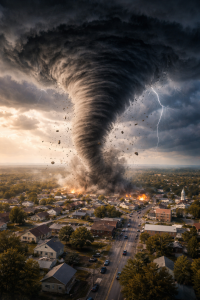
A tornado does not ask permission. It comes when it comes. It does not check your plans or wait until you feel ready. That is part of what makes disruption so difficult. Something that seemed solid can suddenly feel uncertain, and the life you carefully built may no longer hold together in quite the same way. From a spiritual perspective, such moments can become openings. Not because suffering is required, but because disruption sometimes loosens what habit alone would have kept in place.
In nature, tornadoes arise from unstable atmospheric conditions and powerful shifts in wind, temperature, and pressure. Human lives have their own kind of pressure. We can live for years inside roles, expectations, relationships, or beliefs that no longer fit, while another part of us quietly pushes for expression. Eventually the tension becomes hard to ignore. The comparison is only a metaphor, of course, but it captures something real about the moment when an old arrangement can no longer contain what is trying to emerge.
What The Tornado Actually Took
Once the storm has changed the landscape, another question becomes possible: What, exactly, did it take from you?
The answer may include losses that simply hurt, and those need no spiritual explanation. But disruption can also expose parts of a life that had already become too restrictive or no longer true. Sometimes it tears away what had quietly been containing us, even dimming a particular quality of Light that had been trying to find expression.
Maybe it was a career that looked successful from the outside but left something essential in you unfulfilled. Perhaps a relationship had become more performance than genuine connection. You may have been living in a situation where your voice gradually disappeared because keeping the peace felt safer than speaking it. An old belief system might also have begun to fail you, unable to hold what life was actually showing you.
And sometimes what falls away is closer still. It is the familiar version of yourself.
Maybe you were known as the capable one, the person who could always be counted on. Perhaps you learned to be agreeable or strong because that was what life required. The identity helped you belong. It may even have protected you when protection was needed.
So when that identity begins to loosen, the loss can feel surprisingly personal. Even a self we have outgrown can be difficult to release. We knew how to be that person, and others knew us there. But the tornado rarely waits until we feel ready.
Understanding The Wisdom of Destruction
If the tornado can strip away parts of a life that have become too confining, a difficult question naturally follows: Why does growth sometimes require things to break apart at all?
Perhaps because we do not easily let go of what once helped us survive.
The identities and patterns that gave us stability can become deeply woven into our lives. So can relationships, expectations, and familiar ways of seeing the world. Even after they stop serving us, we may hold on because we know how to live inside them. Other people know us there, too. Stepping beyond what is familiar can feel far more threatening than remaining in something we have already outgrown.
The Shell That Protects
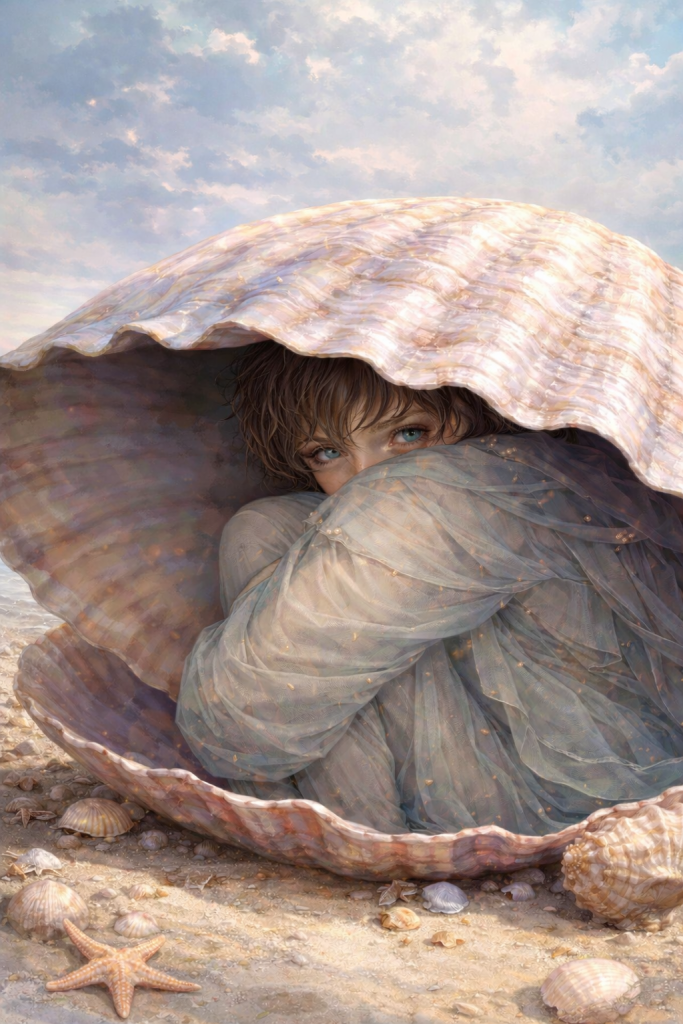
A shell protects life while that life is developing. Without it, something tender might not survive. But a shell is not meant to grow forever with what it protects. Eventually, the very thing that once provided safety can begin to restrict what is trying to grow within it. Nothing has gone wrong. The shell simply cannot keep expanding.
Our lives can work much the same way. We develop ways of behaving, thinking, relating, and understanding ourselves that support us for a certain period of time. They give our lives shape and help us find our place in the world. Then something within us continues growing, while the form surrounding it stays much the same.
At first, we may barely notice. There might be a vague restlessness or a sense that something is missing. Maybe a role we have played for years begins to feel strangely uncomfortable or lacking. Outwardly, everything may still appear to be working, which can make the feeling even harder to understand.
But something has shifted. Sometimes we recognize it and begin making changes on our own. Other times we hang on. We repair the shell, reinforce it, and tell ourselves we should be grateful for what we have. We may even assume the discomfort means something is wrong with us rather than considering another possibility: perhaps we have simply outgrown the life we are trying so hard to preserve.
This is one way of understanding the deeper symbolism of the tornado. It represents a force strong enough to interrupt patterns that might otherwise continue for years. Habit can keep us in place. So can fear, loyalty, responsibility, or simply the comfort of knowing what tomorrow is supposed to look like.
But the tornado disrupts that certainty. This doesn’t mean every painful event was deliberately sent to teach us something. Nor does it mean every loss was spiritually necessary. Life is much too complex for that kind of explanation. Yet once disruption enters our lives, whatever caused it, we may begin seeing things that were almost impossible to recognize while everything remained undisturbed.
Suddenly, what we have been tolerating is harder to tolerate. A truth we pushed aside may refuse to stay quiet. Something we thought was secure may reveal how fragile it had already become.
And occasionally, beneath the life we were trying so hard to hold together, we discover another part of ourselves waiting to be heard.
That is where the wisdom within destruction becomes easier to understand. Not destruction for its own sake, and certainly not punishment. Life itself is filled with forms that emerge, change, and eventually give way. A seed casing has to open before the plant can grow beyond it. Trees release their leaves. Our own bodies are continually letting go of what is no longer needed.
Something similar can happen within us. What appears after disruption is not necessarily a completely different person. More often, qualities that have been present for years finally have room to come forward. Maybe you find yourself speaking more honestly to yourself than before. Creativity returns after being buried beneath years of responsibility. You notice that you are making a decision because it feels right to you, not because everyone around you approves of it.
Sometimes purpose is a quiet voice within before it speaks clearly. This unfolding usually takes time. There may even be a period when no new form has appeared at all, and that can be unsettling. The old structure has cracked, but whatever comes next has not yet taken recognizable shape. You know what you cannot return to, but you may have no idea where you are going. At such a moment, rebuilding the old shell can be terribly tempting. At least it was familiar.
Yet something important can happen in that uncertain space. Questions arise that had little room to surface before. Who am I without this role? What still feels true? Why am I continuing to do something that no longer feels like me? What is asking for my attention now?
The answers do not always arrive together.
One may come through an unexpected conversation. Another might appear as a persistent feeling you can no longer dismiss. You may simply notice that something you once needed from other people does not carry quite the same power over you anymore.
Slowly, your inner reference point begins to change. You become a little less dependent upon being who others expect you to be. Decisions may begin coming from a quieter place within you. There is less need to perform an identity that has become exhausting to maintain, and something more genuine has room to breathe.
From the perspective of Ageless Wisdom, this movement is part of our continuing evolution in consciousness. As we grow in awareness, we begin to recognize more of our deeper spiritual nature. The personality still matters very much. We need it to live, choose, create, love, work, and participate in the world. But it can gradually become less of a mask we defend and more of an instrument through which the deeper Self expresses itself. We might think of this as an inner movement toward alignment.
As consciousness expands, it becomes harder to ignore the distance between what we inwardly know and how we outwardly live. At first, that distance may show itself as little more than discomfort. Later, it can become impossible to overlook. You simply know something no longer fits.
This is where the symbolism of the tornado becomes especially powerful. The tornado does not create the deeper Self. That Self was already there. What the storm can reveal is where the structures surrounding it have become too narrow. Once the shell cracks, Light can enter places that have been closed for a very long time.
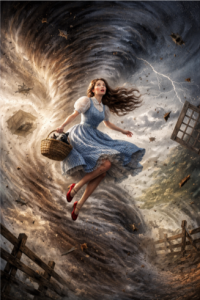
At this point in Dorothy’s journey, her experience begins to reach beyond personal upheaval. Something larger is unfolding, a process of awakening that the Ageless Wisdom traditions have described in many different ways. Dorothy does not understand it yet. Neither do most of us when our own journey begins.
That pattern gives Dorothy’s journey another layer. The tornado carries her out of Kansas. Her awareness begins to change as she encounters Oz, its beauty, its danger, and the companions who reveal different parts of herself. What once seemed like one world gives way to another, and she has to learn how to meet it.
Something similar can happen in our own lives. A disruption may force movement before we feel ready. Then awareness catches up. We begin to see what we had not been willing or able to see before, and our outer life slowly reorganizes around that new understanding. Sometimes the change is visible to everyone. Sometimes almost no one notices at first.
Forms change when they can no longer hold what is developing within them. A role may end, a relationship shift, or an old belief lose its authority. Sometimes a new responsibility appears before we feel ready for it. What looks like destruction from one angle may, from another, be the breaking of a container that had already become too small. Once that happens, even familiar surroundings can feel different. Kansas is still Kansas, but you are no longer seeing it with the same eyes.
The tornado does not erase who you are. It can, however, interrupt the way you have been living long enough for another level of awareness to become possible.
One way to understand a life-altering disruption is as a movement from largely unconscious participation toward more conscious engagement. We begin questioning assumptions that once ran quietly in the background. Old patterns become visible. Choices that seemed automatic suddenly feel like conscious choices. That shift can be exhilarating, but it can also be unsettling.
To understand where the tornado may be taking you, it helps to notice where it is taking you from. In the film, Kansas appears in muted sepia tones. The effect is unmistakable. Life works, but it feels limited and somewhat drained of color. Symbolically, Kansas can represent a way of living mostly through habit, duty, inherited beliefs, and the quiet pull of fear.
Most of us begin there in one form or another. We inherit maps from people who inherited maps from those before them. Usually they hand them to us with love. The maps contain family wisdom, cultural expectations, warnings, values, and ideas about what a good life is supposed to look like. For years, we may have no reason to question them.
Those maps can be useful. They carry real experience and often protect us while we are learning how to find our way. But a map is not the territory. There may come a time when your inner experience no longer fits the lines you were given, when something in you has grown too vivid, too curious, or too awake to remain inside the old boundaries.
That is another way to understand the tornado. It is the moment when the whisper becomes harder to ignore. Restlessness, longing, recurring questions, an unexpected sense that there must be something more, perhaps they have been present for years. Then life changes, and suddenly what was once easy to dismiss is standing directly in front of you.
The Eye of the Storm: Sacred Stillness Within Chaos
We often use the phrase “the eye of the storm” to describe a place of stillness surrounded by chaos. A tornado does not have a stable eye in the same way a hurricane does, so I am using the image here as a spiritual metaphor rather than a literal description of tornado structure. Even when life around us is moving violently, there can be a quieter place within from which we are able to witness what is happening.
Think about a difficult season in your own life. Beneath the fear, anger, grief, or confusion, was there ever a moment when some part of you simply noticed? Perhaps only for a few seconds. The pain was still there, but something in you was aware of the pain rather than completely consumed by it. That witnessing presence is what I mean by the still point.
You do not have to manufacture this quiet center. The practice is learning to notice it. Across spiritual traditions, people have described an inner presence that becomes easier to sense when the noise settles, even briefly. In Ageless Wisdom teachings, it is sometimes spoken of as the still, small voice within.
Many spiritual traditions would call that deeper presence the Higher Self or the Soul. It is understood as the part of us that is more than personality, more than our changing moods, roles, fears, and stories. It carries will, love, and intelligence, yet its guidance is rarely loud. We may miss it for years because the personality is much better at making noise.
Learning to rest in that witnessing awareness, even for a few breaths, can change the way we move through upheaval. It does not make the storm unreal. It does not erase grief or remove the work that healing may require. What it offers is a little inner space. Sometimes that small space is enough to remind us that the storm is happening within our experience, but it is not the whole of who we are.
The Meaning Within Your Tornado
Meaning is not always visible while we are living through a turning point. Some experiences grow out of choices, relationships, or patterns set in motion long before we recognize where they might lead. Others seem to arrive without warning. Years may pass before we understand what changed in us, and some questions may remain unanswered. Even so, experience can become part of an ongoing process of learning. We may finally recognize an old pattern, make a different choice, or notice something that had been asking for our attention for a long time. Once the understanding becomes real, we do not have to remain caught in exactly the same lesson.
Growth also does not require us to romanticize suffering. Still, many of us can look back and see that certain difficult experiences forced questions we might otherwise have postponed for years. Pain can expose a pattern. Loss can change what matters. A life that once felt settled may suddenly ask for a different kind of courage.
From a soul-centered point of view, the question becomes less, “Why was this done to me?” and more, “What am I to learn from this, and what is available to me now?” That shift does not excuse what happened. It turns attention toward the part of you that can still choose, respond, create, and grow. Sometimes that is where new possibilities begin to appear.
Perhaps it is a depth you did not know you had, a clearer sense of what you will no longer accept, or a compassion that became possible because you now understand pain from the inside.
The suffering itself does not have to be called good for growth to come from it. There is a difference. What matters is the capacity within you to meet what happened and decide, slowly and in your own time, what you will make of it. You are more than the event. You are also the consciousness that responds to it.
You might sit with a few questions, gently and without trying to force an answer:
- When you think about the tornado you lived through, what has changed in the way you understand yourself?
- Is there a strength, boundary, sensitivity, or wisdom in you now that was less visible before?
- What did the experience take from you, and what did it reveal?
- Are there parts of the person you became afterward that you have not fully recognized yet?
- If you sit quietly with your life as it is now, what feels more true than it did before?
The Gift the Tornado May Carry
When Dorothy lands in Oz, she opens the door of the familiar farmhouse and steps into a world of extraordinary color. After the sepia tones of Kansas and the violence of the storm, the change is almost overwhelming. Everything is brighter, stranger, and more alive. She has not yet decided whether Oz is wonderful or dangerous. At first, it is both.
That shift from Kansas to Oz can symbolize one of the unexpected gifts that sometimes follows disruption. Not the destruction itself. Not the grief. Those are real, and they deserve whatever time they require. The gift may be something quieter: the possibility of seeing differently. A life that once seemed fixed can begin to reveal choices, questions, and colors you simply could not see before.
Perhaps something has grown in you since your own storm. A strength you did not know you had. A clearer sense of what matters. Maybe you understand yourself differently now, or you have become more willing to listen to the quiet voice within rather than automatically returning to what is familiar.
And beneath all that changed, there may be something else worth noticing.
Some part of you was there through the entire experience. It felt the pain and confusion. It watched things change. It may have been frightened, overwhelmed, or uncertain about what came next, yet somewhere within you was an awareness that could witness what was happening without becoming entirely lost in it.
You may have felt that presence only for a moment. That is enough.
The meditation that follows invites you to become more familiar with that quiet place within yourself. You do not need to understand your storm, explain why it happened, or find a gift in something that still hurts. For a few moments, you are simply being invited to notice the stillness that exists beneath the movement and to rest there.
A Meditation for Your Eye of Your Storm
 Find a quiet place where you will not be disturbed.
This meditation does not require special conditions or elaborate preparation. It only asks for your willingness to be present with your own experience, just as it is.
Sit comfortably with your spine naturally upright and your body at ease. Let your hands rest softly in your lap, palms open, not as effort, but as a simple gesture of allowing.
Take a slow breath in through your nose, feeling your body gently expand. Pause briefly at the top, as if resting at the crest of a wave. Then release the breath fully, letting it fall away without force, carrying with it any tension you may be holding. Do this three times, letting each breath be a little more complete than the last.
Now gently and without pressure, bring into mind, the tornado of your own life and the disruption that divided your story into a before and after. You don’t need to relive it in detail. Simply acknowledge its presence in your history, the way you would acknowledge a distant memory. It is there; it was real, and it was enormous. And you are here, on the other side of it, still alive and breathing.
Notice what arises in the body as you hold this awareness. Perhaps a tightening in the chest, a heaviness in your stomach, or a pressure behind your eyes. Whatever is present, allow it to be present without trying to change it or resolve it or move past it more quickly than it naturally moves. You are not here to fix anything. You are here to witness.
Now, very gently, shift your attention from the storm itself to the one who is observing it. The awareness that notices the tightening in the chest, the presence that is watching the images, and the feelings arise without being swept away by them. Settle your attention here, in this witnessing space, the way you might settle into a comfortable overstuffed chair.
This is the eye, its quiet, clear, untroubled awareness that has been here through every tornado your life has ever produced. It did not flinch when the storm arrived, and it did not leave when the world went gray. It has been watching with this same quality of patient and faithful attention since before you had language for what you were experiencing. Just rest here. Let your breath continue naturally, without direction. Let the thoughts and feelings and images move through the space of awareness the way clouds move through the sky, arising, drifting, and dissolving, while the sky itself remains unchanged. You are the sky. Whatever weather your life has produced, you have never been only the weather.
After several minutes, bring your attention back to the gift. Not to what the storm destroyed, but to what it delivered. Think of one quality in yourself, one capacity or depth of understanding or dimension of compassion that would not exist without the experience of your tornado. Hold it quietly for a moment and let yourself recognize it as yours, earned not through suffering alone, but through the willingness to remain conscious inside the suffering and to let it teach you what it came to teach.
Now, place both hands over your heart and feel the steady rhythm beneath your palms. This heart survived the storm. It is still here, still beating, still oriented toward life and toward love and toward the particular golden road that belongs only to you.
Say inwardly, with as much genuine feeling as you can bring to the words:
“I am grateful for the storm that cracked me open. I am grateful for the color on the other side. I am grateful for the eye at the center that never abandoned me. I am not in Kansas anymore. I am ready to walk the road.”
Now, take three final deep, but comfortable, breaths. Let each exhale be an act of release, of settling more fully into your body this moment, this life that the tornado did not destroy but only relocated into its greater truth.
When you are ready, open your eyes slowly. Look at the world around you for a moment as if seeing it with the eyes you acquired in Oz, the eyes that know color now, that cannot entirely return to gray. Now, carry that seeing with you as you move forward.
The road begins here. It has always begun here, and every storm that ever visited your life was simply the universe clearing the ground for the first golden stone on the road ahead.
And so it is.
Images created by ChatGPT