From Transaction to Co-Evolution
From Transaction to Co-Evolution
By Philip Horvath
— Relating with Value
Value is created in interaction, when we relate with each other.
Whether this occurs on a personal level or a professional level, our interactions with one another are what fuels our world.
But how can we ensure all of our relating creates value?
Let’s take a look at the different modes of relating…
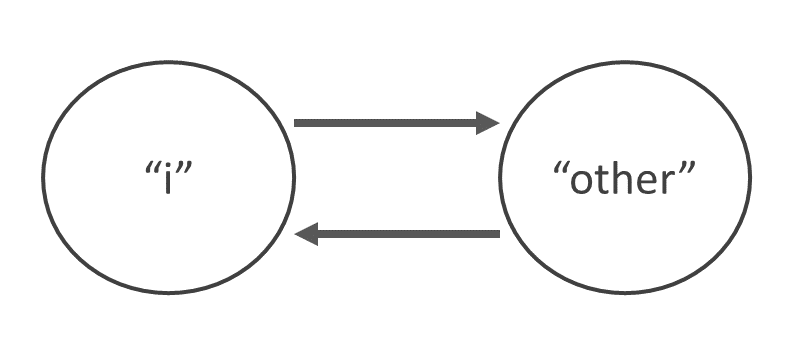
Transactional Relating
Most interactions occur on a transactional level. Transactions happen when “i” exchanges something with “other” — this can be physical, as in actual goods, emotional, as in making each other feel a certain way, or via information, when exchanging knowledge.
Most of the time, the transactional level is fine. It allows us to function in this world. When we go to the market and buy bread, when we say something to our partner and make them feel good, or when our employee sends us the report we asked them to prepare.
Transactional relating works well if the value exchange is clear. But what if the value is unclear, begins to erode or worse, breakdowns occur? In this case, a shift in relating is required.
In those moments we feel anxiety, an incongruence of who we are with what the situation is requiring. But as Kierkegaard said, “anxiety is the dizziness of freedom.” When we feel anxious, we are invited to liberate ourselves from the old sense of self that has become insufficient and move toward more freedom.
As we cannot control “other”, the logical step is to start with ourselves and open up to new possibilities.
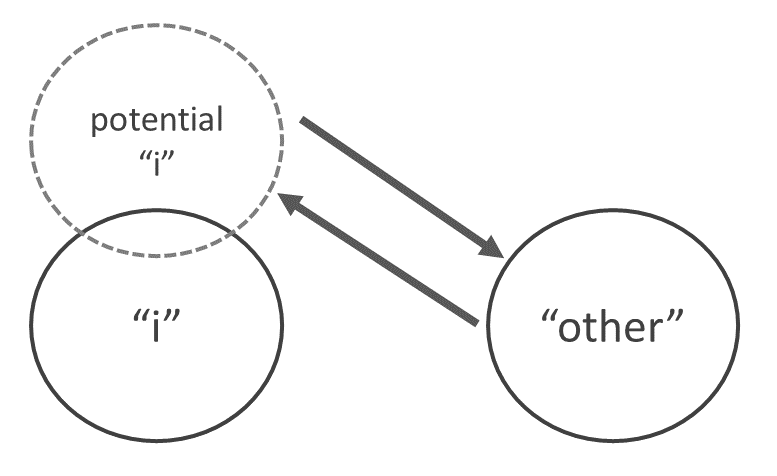
Discovering the Possibility of Self
One thing we can do in pretty much any situation is to shift our sense of self from the known to the possible, to who we can become. In some situations this can be considered learning — and as my father used to say: “a good student can learn even from a bad teacher.”
When we operate from discovery of Self, we let go of who we think we are, to be present to the moment and what the moment requires.
It starts with having an open mind, letting go of preconceived notions and ideas we might be holding about ourselves or the situation. Instead, we shift into presence with “other”, allow ourselves to investigate what the world might look like from their perspective, connect to our sense of empathy. As we do so, we become fluid, flexible, step outside of ourselves.
In doing so, we take the position of the situation, not ours or other’s, and consequently enter a dynamic and synthetic state instead of getting caught up in the dualism of the situation.
This allows for new possibilities to emerge, and in the very least will leave us having grown from the interaction — in itself valuable, if not priceless.
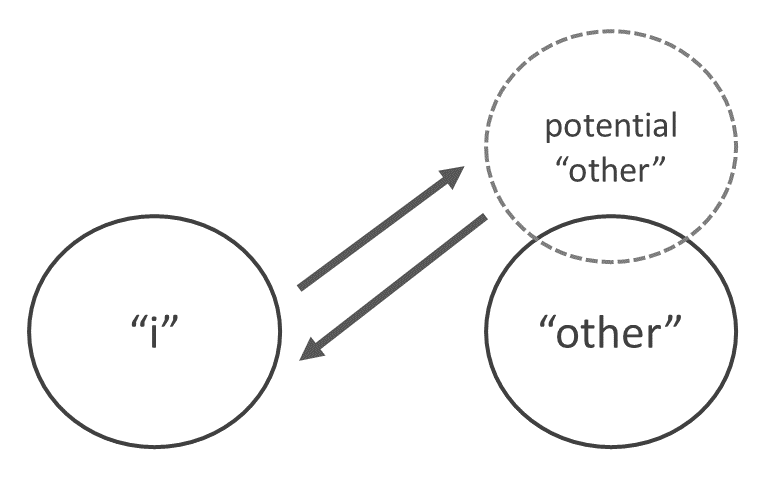
Relating to the Possibility of Other
Another strategy, which can be deployed in tandem, is to allow “other” to be more than it has been for us.
This happens naturally when we teach children. We don’t speak to who they are at the moment, but we speak to who they can become. We naturally assume that they are developing, that something is trying to emerge, which results in patience and care in our interaction with them.
This strategy is a logical choice if we accept that we really don’t know what “other” is in the first place: that what we think we know we know results from past experiences with similar “other”, but that we can never know anything or anyone fully.
Think back to a situation when someone surprised you with their actions in a positive way. They were more than you expected them to be in the first place.
When you speak to the possibility of “other”, you take into consideration that everyone is more like a verb than a noun. Everyone is a process.
Constantly changing and evolving. When you relate to someone in a fixed manner, you box them in. You will also trigger their defenses. If you relate to who they can be, you allow them to be flexible, give them the opportunity to evolve.
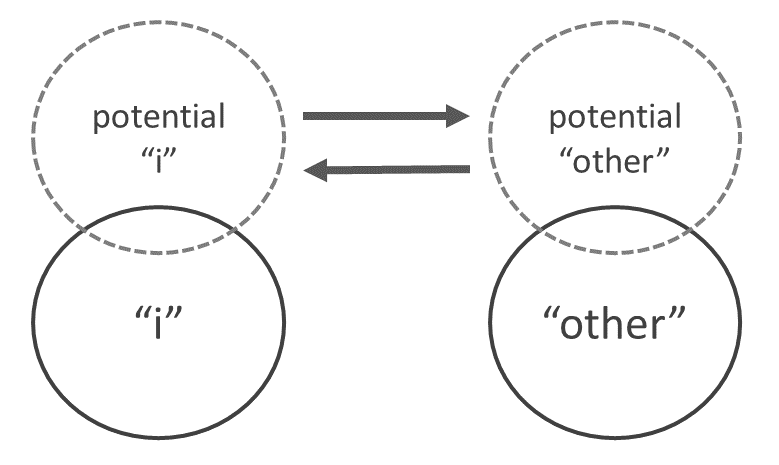
Opening to Co-Evolving
When you combine both of these strategies, and especially when “other” is responding and meeting you on equal grounds, you open up to relating from discovery, and to the possibility of co-evolution.
In co-evolution both you and “other” operate from the realm of possibility rather than a realm of preconceived notions based on past ideas of self.
This is the most powerful way of relating as it results in value for both parties and allows exponential jumps in development to occur. When we release ourselves from past notions of self or other, we also release ourselves from linear trajectories.
As a result, we can both discover something that was not available to either of us before. By doing so, we are now also changing the field of possibility, not just for “i” and “other”, but for everyone else who will interact with either of us in the future.
Relating into the Future
So the next time you find that an interaction feels insufficient, or you get early warning signs that something is not quite going right, remember these simple tools.
Shift yourself, allow the other to shift, and relate from potential instead of based on past notions.
You will find that it opens up a whole new world in your relationships — both personal as well as professional…
I inspire and advise innovators — those who bring in the new: be they creatives, entrepreneurs, corporate catalysts, activists or educators. You can find out more on my website at http://philiphorvath.com. For tweets on culture and future @philiphorvath