
Can AI Think? If You Think, It Can.
Thoughts on the ghost in the machine and what it will take to integrate AI
Philip Horvath
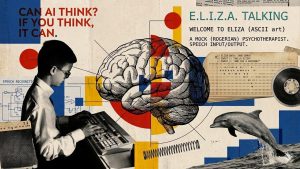 AI created image – and yes, that’s me in 1987 on my second computer
The first computer I encountered wasn’t mine. It was my father’s.
Back in the summer of 1984. My father was a doctor in Germany. The GOÄ had just been introduced, the “Gebührenordnung für Ärzte”. Every medical procedure now needed to be coded in specific numbers before being invoiced. Orwellian beginnings of the healthcare system in Germany. Doing this by human hand was no longer viable.
So the machine arrived.
It was pretty much heavier than I was at the time. I was ten. 64 kilobytes of RAM. Two single-sided floppy drives. A green monochrome monitor showing nothing but ASCII characters. No hard drive. No mouse.
I was totally fascinated. At first I wasn’t allowed to touch it (it was quite expensive back in the day), but after standing behind my father often enough, telling him what to do next, he eventually let me explore it. So I taught myself programming from books and magazines and started my first career.
By the time I was a teenager, I earned my pocket money replacing typewriters with PCs and programming databases. I remember the day my father’s secretary watched as we installed a computer for her. She looked at the computer screen with a mix of fear and fascination in her eyes, the way you look at something that might be about to replace you.
She turned to me and asked: “Can that thing think?”
Eighteen years earlier, at MIT, a different secretary had already found her answer.
In 1966, Joseph Weizenbaum created a program called ELIZA. A simple pattern-matching script that mimicked conversations. No intelligence. No understanding. A very well-designed mirror. It wasn’t even AI yet, just a simple pattern matching and substitution program created to explore communication between humans and machines.
It’s effects disturbed Weizenbaum for years and made him a vocal proponent of dealing with AI very carefully (there is even a Weizenbaum Institute here in Berlin where I have seen a few lectures on cybernetics, AI and its societal implications). In his own words: “I had not realized that extremely short exposures to a relatively simple computer program could induce powerful delusional thinking in quite normal people.”
What had happened was that his own secretary had started using the ELIZA script DOCTOR, which simulated a psychotherapist of the Rogerian school, for real conversations about issues with her boyfriend and actually found genuine relief from it.
She never asked whether the program could actually think. The question didn’t even interest her. She kind of knew that there “was nobody home”, but she experienced something useful, and so she used it.
Two secretaries. Two responses.
But it was never really about the machine, only the mirror it provides.
There was a joke in IT departments back when I worked in tech in the 90s:
Can computers think? If you think they can.
Working in tech support for a while in one of my jobs (and sort of by default for all my friends and family since I was an early digital native), I found that most of the time, the machine wasn’t the issue. When a computer “malfunctioned”, the problem was usually EBKAC: an error between keyboard and chair.
The machine was fine. The thinking had stopped somewhere else.
Forty years later, we now hold tools that were purely in the realm of science-fiction back in 1984. And people, even people who should know better, are asking the same question:
Can AI think?
The technology is nearly unrecognizable, but the risk is identical.
Can AI think? Ask what it’s amplifying.
I love working with AI. I use it every day. Claude, ChatGPT, Gemini, Perplexity and several other tools are woven into nearly everything I produce. I’ve spent years building custom infrastructures that carry my frameworks and voice. Every conversation compounds on the last.
So this essay is not an anti-AI argument.
It is a question about who is doing the thinking.
AI is not intelligence. It is amplification.
It synthesizes. It patterns. It structures. It drafts. It accelerates. Extraordinary capabilities — and this is just LLMs. In my work I deal with innovation in industrial AI, and entire processes and products created with AI and machine learning. Refusing to use these possibilities would be foolish (given that we get to use these tools to push through the current unsustainable world and build one that is not eating the insane amount of resources this current technological readiness level is consuming).
What AI cannot do is care. It cannot hold values. It cannot own consequences. It cannot determine meaning.
Those remain human responsibilities.
Which means that the quality of what AI produces is, at every step, a function of the quality of the human in front of it.
A sharp thinker with AI becomes sharper. A confused thinker produces confusion at scale. A lazy thinker becomes more efficiently lazy.
A fool with a tool is still a fool.
And now the tool is very, very powerful.
Can AI think? It doesn’t need to if you already stopped.
Every week I get AI-generated emails. Often I can tell within the first sentence, sometimes it’s a bit more confusing. The other day I had an entire email exchange with what seemed like a recruiter for an advisory board position. I have to say it was slick. Even though the emails sounded somewhat generic and AI generated, the back and forth and how it picked up on details was pretty impressive. It turned out to be a scam in the end, but it was definitely a sophisticated one.
Occasionally, though, it’s really stupidly obvious.
The other day I got an email that still had the ChatGPT footer at the bottom. “Next we can turn this into a template email you can use for future emails, would you like me to draft it for you?”
The sender had not even read what they sent. Mindless copy and paste.
For me the question of AI is not about productivity, but about abdication.
And it is spreading. Research from BetterUp Labs and Stanford’s Social Media Lab found in 2025 already that 40% of U.S. employees had received AI-generated “workslop” in the previous month. By now, I am pretty sure the number is quite a bit higher. It took two hours of someone else’s time to clean up, on average, per incident. For a 10,000-person company, that’s nine million dollars a year in wasted effort.
Not because AI failed. Because humans stopped actually paying attention.
The machine didn’t stop thinking. It was never thinking to begin with.
The human did. Or rather didn’t.
Can AI think? I’m not worried that it might. I’m worried that people might stop.
I’m not worried about artificial intelligence. I’m worried about the lack of human intelligence.
Across organizations, I’m watching people outsource the wrong things. Thinking. Reflection. Authorship. Discernment. Accountability.
What comes out in its place is recognizable: Shallow work in confident formatting. Generic communication, “told by an idiot, full of sound and fury. Signifying nothing”.
And underneath all of it, the erosion of trust.
Because trust requires presence, requires actual authorship and ownership. The sense that a real human was in the room, made real choices, and most of all: will stand behind them.
When that’s gone, no amount of AI polish will fill the gap.
AI does not create human weaknesses, but it surely reveals them.
The person who always hid behind process now hides behind AI. The organization that already had diffused accountability now has a faster, more efficient, and more invisible way to diffuse it even further.
AI didn’t make people intellectually lazy. It handed them the most efficient amplifier ever invented for a laziness that was already there.
The solution is not less AI. It is more human.
Can AI think? Here’s what happens to a mind that lets it.
This is not a new phenomenon. We have been here before.
We built machines to lift for us. Now we have gyms to go to, to rebuild the muscles we stopped using. We created clothing as an extension of our skin, and over generations, we lost much of the natural protection, the fur our ancestors carried. We built maps, then digital maps, then turn-by-turn navigation. A generation of adults now cannot orient themselves in an unfamiliar city without their phone (I have to admit I am somewhat guilty of that, too. I used to have a great sense of orientation, traveling across continents before there were smart phones, but now I feel like an idiot with google maps showing me the way all too often).
Research published in Scientific Reports (2020) tracked GPS users over time. Greater GPS use was associated with steeper decline in hippocampal-dependent spatial memory. The hippocampus is your brain’s hub for memory and navigation. With disuse, it loses functional density. The GPS didn’t give us a better sense of direction, it actually replaced our natural capacity.
Use it less. Lose it faster.
Now think about what happens when you are outsourcing thinking…
A 2025 peer-reviewed study in Societies examined 666 participants. It found a significant negative correlation between frequent AI tool use and critical thinking.
The mechanism is called cognitive offloading. Handing your thinking to an external system.
MIT researchers named what comes out at the end: cognitive atrophy.
The cognitive effort you don’t perform today is the cognitive capacity you may not have tomorrow.
The secretary’s question in 1984 was about the machine. The question now is about you.
Can AI think? It doesn’t need to. It has your signature.
In most organizations I have seen, when something goes wrong, the first instinct isn’t “what can we learn?” It’s “who caused this?”
Blame and responsibility get confused so casually, most people have stopped distinguishing between them.
Blame is backward-looking. Responsibility is forward-looking. They are not the same.
Blame assigns fault. Response-ability creates the conditions for something better to happen next. It is the ability to respond.
In environments shaped around blame, people learn one thing very efficiently: Hide. Protect yourself. Create cover.
Modern corporate structures have given us sophisticated tools for doing exactly that.
Matrix organizations. Delegation chains. Committee approvals. Multi-stakeholder sign-offs. Corporate personhood. Every one of these was built for legitimate coordination. Every one of them also became a place to hide.
Everyone participated. Nobody owns the outcome. Nobody can be called to account, because nobody actually decided anything. “The process did it.”
Now AI has joined this roster.
“The AI generated it.”
“I was working with the tool.”
“It came out of the system.”
AI has become the newest and most efficient shield for avoiding the responsibility of authorship. Unlike a committee, AI is fast. Unlike a process, it’s invisible. Unlike a hierarchy, it can’t be interrogated. Even people who own the AIs don’t know how they comes up with their answers (and not all of them give us a chance of survival at this point, they too are weary).
But outcomes still affect real people. The email still landed. The document still went out. That school did get bombed. The decision still got made. Somewhere in that chain, a human signed off. Or failed to.
“The AI did it” is not a defense. It is a confession.
Can AI think? No. But CYA culture makes it easy to pretend.
This didn’t start with AI. We learned it early.
Most of us were trained in systems that punished mistakes and rewarded compliance. School taught us to optimize for the right answer, not the honest question. Corporate culture refined it. Avoid risk. Protect yourself. Document your decisions, so you can prove you weren’t responsible if it goes wrong.
The dominant operating system in most organizations isn’t strategy or vision.
It’s CYA. Cover Your Ass.
And CYA produces a specific kind of person. Not bad. Cautious. Compliant. Approval-seeking. Conflict-averse.
It produces work that is technically defensible rather than actually good. Meetings full of people who agree. Hallways full of people who disagree. Cultures where nobody launches anything bold because nobody wants to own the consequences if it doesn’t work (I see this in the innovation theater of lots of companies plenty).
This creates something more corrosive than bad strategy. It creates chronic low-grade anxiety as I pointed out in my last piece on ambiguity.
Because humans are not built for diffused responsibility. We need agency. We need to know where we stand. We need the felt sense that what we do has a relationship to what happens.
Strip that away, through fragmented accountability, through shifting authority, through unclear expectations, and you don’t just lose productivity. You create what psychologists call role ambiguity.
Role ambiguity is a reliable predictor of burnout, of disengagement, of the passivity that makes workslop practically inevitable.
A lack of ownership doesn’t just produce mediocre work. It produces anxious people.
And anxious people reach for shields.
AI is a fantastic shield for the anxious knowledge worker.
Can AI think? That’s not the question.
At some point, adulthood means recognizing something:
This is your life. You are on first.
I don’t mean that in the sense of blame. Not in the sense of “everything that’s happened to you is your fault.” But in an ownership-oriented way. Regardless of where you started, what shaped you, what failed you. You are still the one who decides what you create from here. In this very moment. What you respond with in every situation. Who you become next and what you orient yourself on.
No matter what your organization’s matrix looks like. No matter what the AI produced. No matter how many approvals it went through.
You are still the author.
Authorship over time builds anti-fragility, which creates confidence.
Not the performed showy kind, and definitely not arrogance. On the contrary, a humble kind of confidence.
The word confidence comes from the Latin con-fidere. To have faith with. Trust in yourself, because you have shown up again and again. Because you have kept (or cleaned up) agreements with yourself and others. Because you have faced outcomes honestly, admitted what didn’t work, and stood behind what you did.
Confidence is not a personality trait. It is your track record, the cumulative result of being in integrity with yourself, and accountable to others.
It cannot be generated. Cannot be prompted. Cannot be offloaded.
When you own your thinking, your decisions, your outcomes, something happens. People trust you. Not because you’re always right. Because they can count on you to show up honestly. To say “I got this wrong” rather than “the AI got this wrong.” To stand behind your work, even when it’s imperfect.
Trust doesn’t come from competence, certificates or titles anymore. It comes shared vulnerability and fulfilled agreements. It comes from ownership.
Can AI think? Not if you’re running the 20/60/20 rule.
My friend Ginger originally introduced me to a framework that immediately made sense to me and expresses perfectly how I work with AI. You can find her at motive3.com and I highly recommend following her work and newsletter. I keep learning from her insights and am sure you will too.
The framework is called the 20/60/20 rule. At LUMAN that is our first rule around working with AI and also my personal operating mode:
The first 20% is your job.
Before you open any AI interface, you get to do the actual work. Think. What do I actually want? What matters here? What outcome am I trying to create? What should be avoided? What does quality look like in my own words? What tone, what values, what constraints belong to this specific thing I’m making?
This stage requires thinking. Discernment. A real relationship with your own intentions.
Without it, AI produces what it always produces when given nothing. Technically competent. Structurally sound. Entirely generic. Output that sounds like everyone and belongs to no one.
Most bad AI output doesn’t start with bad AI. It starts with an unclear human.
The middle 60% is where AI can do some “heavy lifting”.
Once you’ve done the thinking, let AI do what it does brilliantly. Research. Structure. Synthesize. Draft. Iterate. Format. Accelerate.
This is the engine room. Use it fully.
The final 20% comes back to you.
This is where our second rule around AI we have at LUMAN comes in: you get to stand behind every single word. Before shipping something, ask yourself: Does this sound like me? Would I put my name on this publicly? Am I proud of this? Does this meet my standard. Not just a defensible standard, but my actual standard.
This final 20% is the part that is beginning to disappear in many organizations. People generate, paste, publish. Without asking whether they would sign their name to it if no one knew AI was involved.
The word responsibility comes from the Latin respondere. To answer for. To be responsible is to be the one who answers. Who can be called to account. Who stands behind what they made.
People are already suggesting AI personhood, but we have already seen that corporate personhood doesn’t work.
AI cannot answer for anything. There is no “self” there that could be in ownership.
AI has no name on the work. You do.
Can AI think? Here’s what I asked it.
I asked my AI tools directly (inspired by my friend Sebnem who send me a prompt for this the other day). How do you see the way I use you?
ChatGPT:
You don’t use ChatGPT to think for you. You use it to make your thinking usable. Most of what you bring in already exists as an idea or direction. The work is turning that into something others can act on. That’s where ChatGPT helps. It structures raw thinking. You use it to iterate fast. Instead of holding ideas in your head, you externalize them and refine them in dialogue. Draft. Challenge. Rewrite. That shortens the path from intuition to execution. You don’t treat it as an authority. You push for clarity and precision. That makes it a collaborator.
Claude:
You’re not using Claude to write things. You’re using Claude as infrastructure for a continuously-evolving system. You load custom skills that encode your frameworks and voice. You iterate constantly, refining, reconsidering, pushing back. You ask for critical thinking, not compliance. You want a thinking partner who challenges gaps, not a yes-machine. That’s genuinely different from how most people use Claude. Most ask one-off questions or request single outputs. You’re building on top.
Notice what is present in both. Intention. Direction. Authorship.
I originate the ideas. I define the themes. I set the quality standard. I push back. I stand behind every word (including the ones in this essay, because, yes, I used AI to help me write it).
The AI doesn’t lead. It responds.
That is not a coincidence. That is the only way this works for me.
Can AI think? That’s still the wrong question.
Back to the two secretaries.
One asked “Can it think?” and was afraid. One never asked and just used it. She found something real in it, even if that something was only the experience of being heard (or more so, getting thinking out because of being prompted with good questions).
For me a better question than whether AI can think is what is the human doing while the machine is doing work?
The Latin root of intelligence is intelligere. Inter, between. Legere, to choose, to read. Intelligence is literally the capacity to read between. To discern. To choose. To distinguish what matters from what merely appears to matter.
AI does not actually choose. It selects the most probable. It does not read between the lines or understands the context it operates in. It predicts the next word. It does not hold values. It mirrors the ones implicit in its training, shaped by the human in front of it.
“There is nobody home”
AI, and technology in general, merely mimic our capacities.
It isn’t actual intelligence, it is artificial intelligence.
Which means the intelligere in the room is still yours.
But only if you keep using it.
What you can practice this week
Before you open any AI tool, spend ten minutes with the first 20%.
Write down, by hand if you can, what you actually want. Not what you want AI to produce. What you want to be real, to exist, to matter, by the time this work is done.
When you receive something AI-generated, ask. Does this person stand behind it? Could they defend it? Would you, if it carried your name?
Once a week, think something through with no tools at all. Build an argument in your head before you type a single prompt. Navigate a familiar route without GPS. Write a paragraph from scratch. Read an actual book and think about what you read. Build the cognitive muscle the way you build any other. By using it. Especially when it would be easier not to.
And when something doesn’t land or work out, own it. Not as blame. As data. As the raw material of your confidence.
The real question
Technology externalizes human capacity. That is its entire value proposition.
Every externalization carries a cost. The faculty we stop exercising atrophies. We built machines to lift, then we built gyms. We built navigation, then we had to learn how to find our way again.
What’s different about AI is the scale. The speed. And the fact that what’s at risk is not a muscle or a sense of direction.
What’s at risk is the quality of human thought itself. And underneath that, and more importantly, the quality of human authorship. Of human presence. The felt sense that you were actually here, making something, standing behind it.
There are future scenarios where we end up in a human zoo, at best “all watched over by machines of loving grace” and I already see intelligent people not just predicting, but embracing the idea of an AGI running the show in the future. This does not seem like a desirable future to me, though.
So maybe the real question was never “Can AI think?”
Maybe the real question has always been:
Will you?
Awareness of what you’re outsourcing.
Responsibility for what you put your name on.
Ownership of the thinking no one else can do for you.
The machine does not think for you. It has never thought for you. Weizenbaum’s secretary found something useful in ELIZA. She still had to live her own life afterward. The relief was real. The work of being human remained hers.
My father’s secretary never stopped asking questions. The question just changed.
About the Author
 Philip’s career spans two roles most people keep separate.
As a keynote speaker, he has stood on stages from Berlin to Bangalore, San Francisco to Tokyo, helping organizations make sense of what AI disruption, culture change, and leadership in the twenty-first century actually require. His talks do not motivate. They reorient.
As a transformation advisor and human-development practitioner, he co-founded LUMAN, the consultancy working with some of the world’s most complex organizations on the conditions that make real transformation possible.
The thread connecting both: the same rigorous, embodied inquiry into what human beings are actually capable of, and what gets in the way.
Years of research across adult development, neuroscience, and transformation – 35 +
Countries where Philip has designed and led transformation programs or held keynotes – 40 +
Intrapreneurs trained through the Siemens Intrapreneur Bootcamp over ten years – 1,000 +
The Siemens Intrapreneur Bootcamp is worth naming specifically. Philip co-designed and co-led it for a decade, one of the most successful intrapreneurship programs ever built inside a DAX 40 organization. Nearly a thousand intrapreneurs trained across more than forty countries. It was not a one-time event. It was a ten-year proof of concept for what human development and transformation at scale actually look like when built right.
You can download a Case Study here.
For more information on Philip, check out his website.