
The Journey Home: The Deeper Meaning of The Wizard of Oz and the Soul’s Journey
Part IV – The Conclusion
Maryann Miller, Msc.D
 Once Dorothy stepped onto the Yellow Brick Road, she quickly discovered an important truth about transformation: no one walks the path entirely alone.
Although the journey inward is deeply personal, it is not solitary. As awareness expands and the seeker commits to conscious growth, different aspects of the self begin to emerge. Some appear as challenges while others appear as companions. Each carries a lesson essential to the unfolding of the soul.
Dorothy’s companions are not random characters she encounters along the way. Each represents a dimension of human consciousness that gradually asks to be recognized and developed. As their journey unfolds, we begin to see that the path toward illumination does not require us to escape our humanity. It instead asks us to understand it more deeply and bring its different aspects into greater harmony.
Meeting the Scarecrow: Awakening the Higher Mind
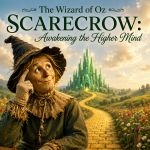 The first companion Dorothy meets is the Scarecrow, who believes he lacks a brain.
This is a curious paradox because throughout the story, the Scarecrow consistently demonstrates insight, creativity, and practical intelligence. Again and again, he solves problems that others cannot. His struggle is not a lack of wisdom. It is a lack of trust in his own capacity to know.
On the spiritual path, the Scarecrow represents the evolving mind.
More specifically, he symbolizes the transition from conditioned thinking to your conscious connection with your Higher Self’s wisdom and understanding.
Early in life, much of what we believe about ourselves and the world is inherited from family, culture, education, and experience. These structures help us navigate life, but eventually they become limiting. As awakening begins, the mind recognizes that its familiar ways of understanding reality are no longer sufficient.
This can create uncertainty. Old assumptions begin to fall away, but deeper wisdom has not yet become stable. We may question our own perceptions or feel caught between what we have always believed and what we are beginning to sense.
Like the Scarecrow, many seekers underestimate their own capacity for insight. They search outside themselves for answers, believing that wisdom belongs to teachers, traditions, or authorities. Yet the journey gradually reveals a different truth: higher wisdom is not something given to you by another. It emerges as the mind becomes quiet enough to receive it.
This does not mean rejecting intellect. The goal is not to abandon thinking but to transform its role. The mind becomes less of a ruler and more of a servant. Instead of controlling awareness, it learns to support it.
The Scarecrow reminds us that true intelligence is not measured simply by how much information we possess. It also shows itself in our willingness to remain open, question what we have assumed, and allow our thinking to come into closer alignment with deeper truth.
Meeting the Tin Man: Reawakening the Heart
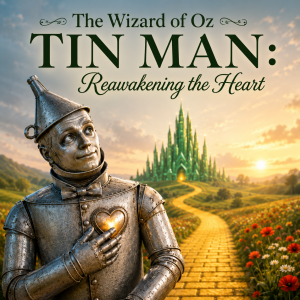 The next companion Dorothy encounters is the Tin Man, who believes he has no heart.
Frozen in place and unable to move without assistance, he represents what happens when the emotional life becomes disconnected from its natural flow.
Many people protect themselves from pain by gradually closing their hearts. Disappointment, betrayal, loss, grief, and fear create protective layers that limit vulnerability. Over time, these defenses can become so familiar that they feel normal. The result is not the absence of feeling, but the restriction of it.
The Tin Man represents the emotional body seeking restoration.
His longing for a heart reflects the soul’s desire to reconnect with compassion, empathy, and authentic feeling. Yet throughout the journey, he repeatedly demonstrates profound kindness and sensitivity.
Like the Scarecrow, he already possesses the very quality he believes he lacks.
The spiritual path does not ask you to become less feeling. It asks you to feel more consciously. This requires courage because an open heart experiences both joy and sorrow more deeply. It allows love to flow more freely, but it also requires a willingness to remain present with pain rather than avoiding it. As the heart awakens, compassion naturally expands. You begin to recognize your shared humanity with others. Forgiveness becomes more possible. Judgment begins to soften. Relationships shift from being transactions designed to meet personal needs into opportunities for connection, growth, happiness, and service.
The Tin Man reminds us that the heart is not made stronger by closing. It becomes stronger through its willingness to remain open.
Meeting the Cowardly Lion: The Development of Spiritual Courage
 The third companion Dorothy meets is the Cowardly Lion, who believes he lacks courage.
Like the Scarecrow and the Tin Man, the Lion already possesses the quality he seeks. He repeatedly acts despite his fear. This is the essential lesson: courage is not the absence of fear. It is the willingness to move forward in the presence of fear.
The Cowardly Lion represents the awakening of spiritual will.
From an ageless wisdom perspective, the Lion represents the awakening and refinement of the will, not the forceful will of the personality that seeks control or dominance, but the deeper spiritual will that aligns with the wisdom of the soul.
Spiritual courage can mean remaining open when you would rather close yourself off, choosing truth even when comfort would be easier, or following inner guidance when no one around you can validate what you sense. At other times, courage is simply continuing when the next step is unclear. It may ask you to face your shadow, release an identity or belief that no longer serves your growth, or act from your deeper values while still feeling vulnerable.
In many spiritual traditions, courage is understood as a quality of the awakened heart and aligned will working together. It is the strength to stay present with your experience rather than retreat into distraction, denial, or fear.
This kind of courage often appears in quiet ways. It may be the pause before a reaction, the honesty to admit what you truly feel, or the willingness to forgive when part of you would rather hold on. Sometimes it is asking a deeper question. Sometimes it is beginning again. And sometimes the bravest thing is allowing yourself to become more fully who you truly are.
The Cowardly Lion’s journey teaches us that courage is not something given to us from the outside. Like the Scarecrow’s wisdom and the Tin Man’s capacity to love, it is already present within us. What appears to be a lack of courage is often a lack of trust in the courage we already possess. As Dorothy and her companions discover, the path itself reveals what has always been there. The Lion does not find courage at the Emerald City. He remembers it.
As the soul begins to guide the personality more consciously, there comes a point when insight and compassion are no longer enough. The seeker must choose to act. This often requires difficult decisions. You may need to release old identities, leave familiar environments, establish healthier boundaries, or follow an inner knowing that others do not understand.
These choices rarely feel comfortable. The personality seeks certainty and security. The soul seeks growth and authenticity. The tension between these two impulses can feel overwhelming. Yet each time you choose alignment over comfort, your inner strength grows. True courage is quiet. It is not dramatic or forceful. It is the willingness to take the next step without guarantees.
The Lion also reminds us that fear is not evidence that we are moving in the wrong direction. Often, it is evidence that we are approaching meaningful change. So, the goal is not to eliminate fear. The goal is to develop a deeper trust in what is calling you forward.
The Companions Together: The Integration of the Personality
Seen together, Dorothy’s companions represent three essential dimensions of human experience: mind, heart, and will.
The Scarecrow points us toward wisdom, while the Tin Man brings the heart into the journey. The Lion adds something different: the courage to act on what we know and love.
Transformation requires the development and integration of all three. When the mind operates without the heart, it becomes detached and analytical. When the heart functions without wisdom, it can become overwhelmed or misdirected. When will is separated from wisdom and compassion, it becomes forceful and controlling.
The path of illumination asks for balance. The soul expresses itself most fully when wisdom, love, and purposeful action work together. However, this integration does not happen all at once. It unfolds gradually through experience, reflection, and conscious choice.
Each challenge along the path becomes an opportunity to strengthen one of these capacities, and each step along the Yellow Brick Road brings them into greater harmony.
The Emerald City: The Vision of Higher Possibility
 Eventually, Dorothy and her companions arrive at the Emerald City. Brilliant, beautiful, and filled with promise, it represents the seeker’s first significant experience of expanded consciousness. After the uncertainty and challenges of the journey, there is a growing recognition that another way of living is possible, one guided less by habit and fear and more by a deeper awareness of what feels true.
The Emerald City symbolizes vision, not simply the ability to see more, but the capacity to perceive life from a broader and more integrated perspective.
At this stage of the journey, the Ageless Wisdom teachings often begin to resonate in a new way. Ideas that once seemed abstract or merely philosophical become meaningful through direct experience. New levels of awareness bring a sense of inspiration, hope, and renewed purpose. The seeker begins to glimpse the possibility that life has a deeper meaning and that the journey of transformation is not only real, but attainable.
These early experiences of expanded awareness can feel exciting and affirming. They offer a glimpse of what may become possible as consciousness evolves. Sometimes that glimpse is enough to encourage us to keep walking, even when we still have questions.
Yet the Emerald City also contains an important lesson: everything appears green because everyone is required to wear green glasses.
This symbolism is profound.
Even elevated states of awareness can still be filtered through perception. It is very important to learn the difference between direct experience and our interpretation of it. Think about this for a moment. A meaningful spiritual experience can quietly become part of a new identity, or a teaching that once opened the mind can harden into a fixed belief. Even a valuable insight can become a conclusion too quickly, when it might have been an invitation to keep asking deeper questions.
The Emerald City offers a gentle caution here. No single experience, no matter how profound, means that the journey is complete. There is always more to understand.
The Wizard: Reclaiming Inner Authority
 When Dorothy and her companions finally meet the Wizard, they discover that he is not what they expected. The great and powerful figure they sought turns out to be an ordinary man hiding behind illusion. This revelation marks a pivotal moment in the journey.
The Wizard represents external authority.
Throughout life, we often believe that someone outside ourselves holds the answers we seek. We look to teachers, institutions, traditions, experts, and systems to tell us who we are and what we should do.
There is value in guidance. Teachers can illuminate the path, wisdom traditions can offer perspective, and communities can provide support. Yet no external source can do the inner work for us. At some point, you must move beyond dependency and reclaim you own authority.
The Wizard cannot give Dorothy and her companions what they seek because they already possess it. He can only help them recognize what has been present all along. This is a turning point in every spiritual journey. The realization dawns that wisdom cannot be borrowed. Love cannot be given from outside. And courage cannot be transferred. These qualities must be discovered and cultivated within.
The Wizard reminds us that authentic guidance empowers rather than creates dependence. Its purpose is not to gather followers but to help individuals trust their own deeper knowing.
The Flying Monkeys: The Power of Conditioned Patterns
 The Flying Monkeys often appear frightening and chaotic, yet they represent something familiar to every seeker.
They symbolize the conditioned patterns that carry us away from simply being here, fully awake to this moment
Old fears, limiting beliefs, emotional reactions, and unconscious habits can sometimes seem to have a life of their own. Without awareness, they can shape our responses before we even realize what is happening. The Flying Monkeys help us see how easily old conditioning can carry our attention away from what matters most.
As awareness grows, however, their influence begins to diminish. The goal is not to fight these patterns with force. It is to understand them. When brought into awareness, unconscious habits lose much of their control. What once felt overwhelming becomes workable.
The Ruby Slippers: The Power Already Within
 Throughout the entire journey, Dorothy carries the means of returning home.
The Ruby Slippers symbolize the latent spiritual capacities that exist within every human being. They represent inner wisdom, connection to the soul, and the ability to align with deeper truth. In the Ageless Wisdom traditions, they can also be understood as the divine potential that lives within each person, the inherent spark of higher consciousness that remains present regardless of life’s circumstances.
Although this inner potential is always available, it often lies dormant beneath layers of conditioning, fear, distraction, and identification with the personality. Much of the spiritual journey involves gradually removing these layers so that what has always been present can emerge into conscious awareness.
The slippers are placed upon Dorothy’s feet which is an image rich with symbolic meaning. Feet represent our connection to the Earth and our ability to move forward on the path. The message is profound: the power that guides us home is not separate from our everyday lives. It is carried within each step we take and revealed through each of the choices we make.
In many metaphysical traditions, the journey of the soul is not one of acquiring something new, but of re-member-ing what has been forgotten. The soul already carries the wisdom, love, and creative power needed for its evolution. What is required is not attainment, but recognition.
Yet Dorothy does not recognize the significance of the slippers until the very end. This reflects a central paradox of transformation. We spend much of our lives searching outside ourselves for answers, fulfillment, and meaning, only to discover that what we seek has been quietly present within us all along.
The path is necessary not because it gives us something we do not already possess, but because it helps us recognize what has always been ours. What happens along the way, sometimes through a lesson, sometimes through a challenge or an unexpected companion, gradually prepares us to become conscious of what was previously hidden from our awareness.
The soul’s deepest gifts often remain dormant until we are ready to use them wisely. Intuition may become more dependable. Compassion can deepen in ways we did not expect, while discernment and inner strength develop through the ordinary choices of daily life. With time, we may also become less easily persuaded by appearances.
The Ruby Slippers remind us that authentic power does not come from external authority, status, or achievement. It arises from alignment with the deeper wisdom of the soul.
There is another important truth hidden within this symbol. Dorothy cannot activate the slippers for someone else, nor can anyone else use them on her behalf. The journey home is deeply personal. Teachers may guide us, companions may walk beside us, and wisdom traditions may illuminate the way, but each of us must ultimately choose to awaken to our own inner authority.
The slippers do not transport Dorothy to a new reality. They return her to the truth of who she has always been. So it is with the spiritual journey. The power we seek is not elsewhere. It has always been within us, patiently waiting for the moment when we are ready to trust it, embody it, and walk consciously in its Light.
Toto: The Voice of Intuition
 Often overlooked, Toto plays a crucial role throughout the story. He is the one who pulls back the curtain and reveals the truth about the Wizard. While the others are captivated by appearances and intimidated by the illusion of power, Toto remains curious, attentive, and unafraid to investigate what lies beneath the surface.
Toto represents intuition.
Unlike the analytical mind, intuition responds directly and immediately to what is true. It does not explain itself in detail or construct elaborate arguments. It simply knows. Intuition often appears as a subtle feeling, a quiet inner prompting, a sense of resonance, or a gentle nudge that cannot be fully explained through logic alone.
Because intuition rarely speaks loudly, it is easy to dismiss. The mind often demands certainty, evidence, and immediate answers, while intuition offers only a quiet invitation to pay attention. In a world that places great value on analysis and external validation, many people learn to ignore this inner knowing or doubt its reliability.
Yet intuition grows stronger when it is honored.
Like any meaningful relationship, trust develops through experience. The more you pause to listen, the more you begin to recognize its unique quality. You may notice that certain choices feel expansive while others create an inner contraction. You may discover that what initially appeared to be a vague feeling was actually a deeper wisdom guiding you toward resonance and alignment.
This does not mean that intuition is always dramatic or unmistakable. Especially in the beginning, it may be difficult to distinguish genuine intuition from fear, desire, or habitual thinking. But the more you practice listening to it and observing the results, the easier it becomes to recognize its particular voice. Learning to trust intuition does not mean abandoning reason. Your mind still has an important role to play. There may be times, however, when careful reasoning points you in one direction while your intuition persistently points you in another. Those moments can require real trust. As your experience grows, you become better able to discern when that inner knowing deserves your attention. In time, intuition and thoughtful reasoning can develop a natural partnership, allowing the quiet guidance of the soul to become increasingly recognizable.
As your confidence in intuition grows, you become less dependent on external approval and more willing to trust your direct experience. You begin to recognize that your deepest guidance rarely arrives through force or urgency. It emerges through stillness, attention to the present moment, and a willingness to listen beneath the noise of fear, expectation, and habit.
Toto reminds us to remain curious, attentive, and willing to question appearances. He teaches us that truth is not always found in what is loudest, most impressive, or most convincing. Sometimes the deepest truths reveal themselves not through analysis, but through our willingness to notice what has quietly been there all along.
The more consistently you honor your intuition, the more trustworthy it becomes. Over time, what once felt like a faint whisper begins to develop into a steady inner compass, one that helps you recognize what is aligned with your deeper nature and what is not. In the end, it is intuition that helps reveal the difference between illusion and truth. Like Toto pulling back the curtain, it gently invites you to look beyond appearances and trust the wisdom that has always lived within you.
I would like to offer a personal reflection here. For many decades, I have intentionally cultivated a relationship with my intuition and made it an essential part of my spiritual life. Learning to trust it did not happen overnight. In the beginning, I often questioned whether what I was sensing was genuine intuition, wishful thinking, or simply the voice of habit and conditioning.
Over time, I learned that intuition becomes clearer through practice, patience, and honest observation. I began paying attention to the moments when my inner guidance proved accurate and to the times when I had ignored it. I also learned the importance of partnering intuition with discernment and thoughtful reflection. Intuition is not a replacement for reason. Rather, it works most effectively when the wisdom of the heart and the clarity of the mind support one another.
As this relationship deepened, intuition became one of my most trusted sources of guidance. Today, it plays an important role in all major decisions in my life. What once felt like a faint whisper has become a steady and reliable presence, and yours can too.
My encouragement to you is simple: give your intuition the attention and respect it deserves. Notice when it speaks, and then pay attention to what happens when you follow that guidance. Keep using your mind. Question yourself when needed. In time, this honest observation can help you distinguish a genuine inner prompting from fear, wishful thinking, or an old habit speaking in a familiar voice.
With time and practice, you may discover that intuition is not an occasional experience but a trusted companion on your journey. As your confidence grows, what once seemed subtle and uncertain can become a clear and dependable source of inner guidance.
Home: Returning to Your Essential Nature
At the end of the story, Dorothy returns to Kansas. Yet she does not return as the same person who left. The landscape is familiar, but her way of seeing has changed. What once appeared ordinary now carries a deeper meaning because she has been transformed by the journey itself. This is the true nature of spiritual transformation. The purpose of the path is not to escape the world, but to engage with it more consciously. Illumination is not found by leaving life behind. It is discovered by learning to live within life with greater awareness, compassion, and presence.
The spiritual journey gradually reveals that home is not a physical destination. It is a state of inner alignment, a living connection with the deeper essence of who you are beneath the roles you play, the experiences you have accumulated, and the identities you have outgrown. Home is the quiet center within you that remains steady beneath the changing circumstances of life. It is the place within that remembers your wholeness even when the outer world feels uncertain. So, the Yellow Brick Road does not lead you away from this place. It leads you back to it.
As the seeker matures, an important realization begins to emerge. The companions can be understood as expressions of qualities already present within you, waiting to be recognized and developed. Through the Scarecrow, you encounter your capacity for wisdom. The Tin Man brings you into a deeper relationship with love, while the Cowardly Lion asks you to discover courage in the presence of fear. And Toto, often quietly at Dorothy’s side, reminds you to trust intuition.
Even the challenges Dorothy encountered served a sacred purpose. Meeting the shadow invited greater self-understanding, while the obstacles along the road asked her to keep choosing the path. Sometimes guidance appeared through another person. At other times, it had to be heard quietly from within.
And so, the deeper meaning of The Wizard of Oz is not that Dorothy found her way home. It is that she discovered she had never truly been separated from it.
Home is not a distant place waiting to be reached. It is the quiet center within you that remains unchanged beneath the movement of life. It exists beneath the roles you play, the experiences you have accumulated, and the identities you have outgrown. The Yellow Brick Road does not lead you away from this center. It leads you back to it.
As we mature spiritually, something important begins to come into view. What we once searched for outside ourselves is increasingly recognized within. The companions helped Dorothy discover qualities she did not yet trust in herself, while the challenges forced those qualities into use. The path did not create them. It gave her the experiences through which she could finally recognize them.
The journey toward illumination is not about becoming someone else. It is about remembering who you have always been.
Step by step, experience by experience, your soul gently calls you home, not to a distant destination, but to the deepest truth of your own being. And when you finally recognize that what you have been seeking has been quietly present within you all along, the journey itself becomes an expression of awakening.
What once seemed like a search for meaning becomes a remembrance of your inherent wholeness and your enduring connection to the greater life of which you are a part.
You discover that the path, the traveler, and the destination have never been separate. They have always been one. The journey was never about reaching somewhere else or becoming someone new. It was about remembering the truth of your own essential nature and returning, consciously and wholeheartedly, to the home that has always existed within you.
Perhaps this is the invitation the story offers each of us. Walk with greater awareness. Meet the shadow with compassion when it appears. Let wisdom grow through experience, allow love to remain alive, and find the courage to trust the quiet guidance that emerges from within. The path to illumination is not a journey away from yourself. It carries you more deeply into the living recognition of who you truly are.
For in the end, the greatest discovery is not that you have arrived somewhere new, but that you have awakened to the truth that you were never truly lost.
Following: A Meditation for the Newer Seeker and a Meditation for the Advanced Traveler
Meditation 1: For the Seeker Newer to the Path
Discovering What Is Already Within You
Find a quiet place where you can be comfortable for a few minutes without interruption. Allow your body to settle naturally, without effort. Let your hands rest gently, and if it feels right, allow your eyes to close.
Take a slow breath in through your nose, and let it out gently through your mouth. Again, breathe in, allowing your body to relax. And as you exhale, allow yourself to arrive fully in this moment.
As you take another breath, notice the simple movement of life within you. You do not need to change anything. There is nowhere you need to go and nothing you need to accomplish during these few moments.
Simply be here.
Now, imagine yourself standing on the Yellow Brick Road. You do not need to see the entire road or know where it eventually leads. You can see only enough of it to take the next few steps, and for now, that is enough.
Notice what is around you. Perhaps there are trees, flowers, an open sky, or sunlight falling across the road. Somewhere far ahead is the Emerald City, but you are not trying to reach it today. It represents a possibility, a greater awareness toward which you are gradually growing.
For now, your attention is on the road beneath your feet.
As you stand there, remember the companions Dorothy met along the way. Each one was searching for something that was already within.
Bring your attention first to your mind. Think of the Scarecrow and his search for wisdom.
Inwardly, ask yourself: What am I beginning to understand about myself that I did not understand before?
Do not search for an answer. Just listen.
Now bring your attention to your heart. Remember the Tin Man and his desire to love and feel more fully.
Ask inwardly: Where might I allow a little more love, compassion, or understanding into my life?
Again, there is no need to force an answer. A feeling may arise. A person may come to mind. Or perhaps there is only silence. Let whatever comes be enough.
Now remember the Lion.
Think about something in your life that may be asking for courage. It does not need to be something dramatic. Spiritual courage often appears in ordinary moments. Perhaps you need the courage to speak honestly, forgive someone, make a change, release an old belief, or simply take a step when you cannot yet see what comes afterward.
Ask yourself: What is one courageous step I am ready to take?
Pause and listen.
Now imagine Toto walking quietly beside you. Let him remind you of intuition, that subtle inner knowing that may not always explain itself.
Bring to mind a decision, question, or situation in your life. Rather than trying to solve it, become quiet inside and ask: What do I sense about this?
Notice what arises before your thinking mind begins analyzing it. Perhaps it is a feeling, an image, a word, or simply a sense of yes, no, wait, or not yet.
You do not have to act on it immediately. You are learning to listen.
This is how trust begins.
Now look down and imagine that you, too, are wearing Ruby Slippers. Let them remind you that you do not have to search outside yourself for everything you need. Wisdom, love, courage, intuition, and the capacity to grow spiritually are already present as possibilities within you. The journey helps you discover them and learn how to use them consciously.
Take another slow breath.
Imagine yourself taking a single step forward on the Yellow Brick Road.
Just one.
You do not need to know where the entire road leads. Your task is simply to meet the next step with awareness and willingness.
As you prepare to return your attention to the room, place a hand over your heart if that feels comfortable. Remind yourself quietly:
I am learning to listen.
I am learning to trust.
I am willing to take the next step.
Take another gentle breath. Become aware of your body, and your surroundings.
When you are ready, open your eyes.
The road is still there.
And you are already walking it.
And So It Is
Meditation 2: For the Seasoned Traveler
Walking in Conscious Alignment
Find a place where you can enter stillness without interruption. Assume your regular meditation posture. Close your eyes and allow the activity of the outer world to become less important for a while.
If you have a breath practice, begin it, or take a slow, conscious breath.
As you release it, allow your attention to move inward.
You have traveled this road for some time. You have known periods when the way ahead seemed unmistakable, and others when you questioned almost everything. You have encountered parts of yourself you welcomed and others you would rather not have seen.
Still, you continued.
For these few moments, release the need to measure how far you have come. Spiritual growth cannot always be recognized by looking backward or calculating progress. Sometimes its deepest evidence is found in how you meet what is happening now.
Bring your awareness to the activity of your mind.
Notice whatever thoughts are moving through it without trying to stop them. Observe them as they arise. Some may be useful. Others may be old patterns repeating themselves.
Ask quietly:
Is my mind serving my soul, or am I allowing thought to lead me away from what I already know?
Remain with the question.
Now bring your awareness to your heart.
Notice what is there without judgment. Love may be present. Perhaps grief, tenderness, gratitude, disappointment, or something you cannot easily name.
Allow it.
The awakened heart does not require you to avoid difficult feelings. It asks you to meet them consciously without allowing them to close the doorway to love.
Ask: Where is my heart being asked to remain open?
Listen.
Now become aware of your will, that part of you capable of choosing and acting.
There is the personal will that pushes, controls, insists, and tries to make life conform to expectation. And there is another quality of will, quieter but stronger, that becomes available when your choices come into alignment with the deeper wisdom of your soul.
Ask yourself: Where am I forcing?
Then wait.
Ask another question: Where am I being quietly called?
Notice the difference.
Bring your attention now to intuition.
You have probably heard its voice many times by this point in your journey. Sometimes you trusted it. Sometimes you questioned it. Perhaps there were times when you ignored it and understood only afterward what it had been trying to tell you.
Become very still.
Bring to mind something in your life that is asking for guidance now.
Do not analyze it yet.
Listen first.
What is the first quiet knowing beneath your thoughts?
Remain there for several breaths.
Now allow your reasoning mind to enter gently. Let intuition and reason meet rather than compete. One does not have to silence the other. Ask whether what you sensed remains steady when examined thoughtfully.
Listen again.
This relationship between intuition and reason can become increasingly refined. Neither needs to dominate. The mind can examine, discern, and help translate what the quieter guidance of your soul reveals.
Now imagine yourself once again on the Yellow Brick Road.
You have walked far enough to know that the road does not always appear the way you expect. There have been turns you could not anticipate. People have entered your life and left it. Experiences you once resisted may later have revealed their meaning.
Look down at the road beneath you.
Then become aware of the Ruby Slippers.
They have been with you all along.
Let them represent the spiritual capacities that have gradually awakened through your journey. Not accomplishments to claim. Not evidence that you have arrived. They are capacities entrusted to you and still being refined through the way you live.
There is humility in recognizing this.
The seasoned traveler understands that a glimpse of expanded awareness is not illumination itself. A profound spiritual experience does not mean the journey is complete. The path continues to reveal subtler attachments, quieter forms of fear, deeper expressions of love, and new opportunities to live what you have come to understand.
Rest for a moment in that recognition.
Now allow the Emerald City to appear in the distance. Do not rush toward it. Let it represent the continuing expansion of consciousness, something that calls you onward while reminding you that every level of awareness can reveal another horizon beyond it.
Then let even the Emerald City fade from view.
Remain only with the road beneath your feet.
Your life is the path.
Your relationships are part of the path. Your choices are part of it. The difficult conversation, the unexpected change, the person who challenges you, the moment when intuition whispers and the mind hesitates, the opportunity to choose love rather than reaction, all of these become places where spiritual understanding is tested and lived.
Take a slow breath.
Bring your awareness to that quiet center within you that has remained beneath every change you have experienced.
Rest there.
No striving.
No declaration of arrival.
Only recognition.
As you prepare to return to ordinary awareness, ask one final question: What is mine to live more consciously now?
Do not demand an answer. Allow the question to travel with you.
Take another slow breath and become aware again of your physical body. Feel the surface supporting you. Notice the room and the sounds around you.
When you are ready, open your eyes.
The Yellow Brick Road was never meant to remove you from ordinary life. It teaches you how to return to ordinary life differently, carrying a little more wisdom into your thinking, a little more love into your relationships, greater courage into your choices, and deeper trust in the quiet guidance of your soul.
And you keep walking.
And So It Is