
The Yellow Brick Road: A Map of the Soul’s Awakening
Maryann Miller, Msc.D.
Part I of a Series on the Wizard of Oz Movie, including Meditations
 A Series Introduction
Most of us first encountered The Wizard of Oz as children. We read about it or watched the movie before we had the capacity to understand much of what we were actually receiving. To us, it was a fairy tale, a colorful adventure, and a story about a girl who wanted to go home. We laughed at the Scarecrow, felt afraid of the Witch, and cheered when the curtain was pulled back. When we grew up, it became a childhood memory, charming and familiar, yet, something we thought we had left behind.
But some stories do not stay behind. They travel with us. Years later, they can surface at unexpected moments, speaking to us differently at forty than they did at seven and revealing something new as we change. The Wizard of Oz is one of those stories. Beneath its familiar characters and bright colors is a remarkably rich map of the human soul’s journey toward wholeness. It was there all along. Sometimes a scene we barely noticed as a child can suddenly feel as if it were meant for the person we have become.
The Man Behind The Story
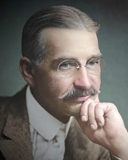
That depth did not appear by accident. L. Frank Baum, who wrote the original novel in 1900, was deeply immersed in the Theosophical tradition, a late nineteenth-century metaphysical movement founded by Helena Blavatsky. It sought to bring together esoteric wisdom from Eastern and Western spiritual traditions, what IFGT calls the Ageless Wisdom, into a broader understanding of consciousness, the soul, and the nature of reality. Baum’s mother-in-law, Matilda Joslyn Gage, was herself a prominent Theosophist and had a significant influence on his thinking. Theosophical teachings about the evolution of consciousness, the threefold nature of the human being, higher planes of reality, and the soul’s return to its divine source can be seen throughout the Oz story. From this perspective, the esoteric reading does not feel like something added later. It appears in the structure of the story from the very beginning.
Once you begin reading the story through this lens, familiar details take on a different life. The tornado starts to look like more than a plot device. The yellow brick road takes on a deeper meaning. Dorothy’s companions begin to resemble parts of ourselves. Even Dorothy changes before our eyes. She looks less like a lost child and more like a soul moving through an ancient inner journey, from unconsciousness toward consciousness, from the false self toward the true self, and out of the gray world of inherited patterns into the vivid, sometimes frightening, aliveness of a life consciously inhabited.
What This Series Is About
This series is an invitation to walk the yellow brick road as if for the first time, with the eyes of someone who suspects, perhaps has always suspected, that the story is about you. Not only in the broad sense that great stories can speak to everyone. I mean you personally. Your tornado. The companions you meet. Your shadow, your wizard, your own version of Kansas, and the particular shade of Oz that waits beyond what you already know. Even the Light symbolized by the ruby slippers begins to feel more personal when you imagine them on your own feet.
Each part of this series will take one element of the story and look at it closely, exploring its esoteric meaning, its psychological resonance, and its spiritual relevance to a soul in the midst of awakening. We will begin with the tornado, the sudden disruption that throws Dorothy out of the familiar and sets the journey in motion. From there, we will meet the companions, encounter the shadow, discover what the Wizard really is, and keep walking the long golden road until Dorothy finally closes her eyes, presses her heels together, and speaks the words that have echoed through generations: There is no place like home.
The story also carries the shape of the archetypal Hero’s Journey described by Joseph Campbell. Dorothy represents the Soul, entering the material world of Kansas and longing for its true divine Home. The tornado disrupts ordinary consciousness and sends the soul onto a path it did not consciously choose. After that, the people Dorothy meets and the obstacles she faces can be read as reflections of forces alive within us. One symbol soon becomes impossible to miss: the Yellow Brick Road.
The Yellow Brick Road
The Yellow Brick Road is widely interpreted as a path of spiritual initiation. It is paved in gold, the alchemical color associated with solar consciousness and enlightenment. In esoteric tradition, gold also represents purification and the higher possibilities of the human spirit. Walking this road suggests a conscious commitment to the inner journey. Step by step, the traveler keeps choosing the path.
Dorothy’s Three Companions, The Threefold Nature of Man
Dorothy does not walk alone. The three companions Dorothy meets represent the three aspects of the human being:
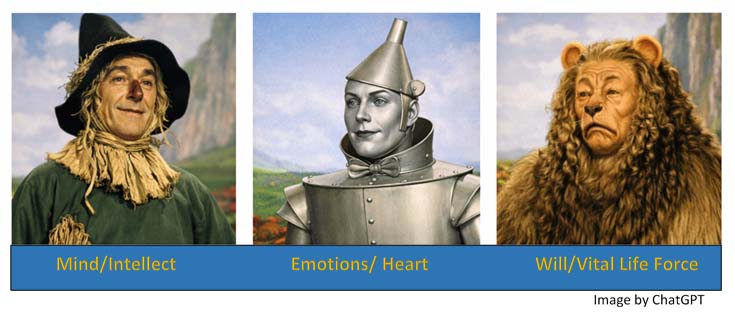
The Scarecrow (Mind/Intellect)
The Scarecrow longs for a brain, yet he demonstrates wisdom throughout the journey. He symbolizes the mental body, already capable of intelligence but uncertain of its own capacity. Esoterically, this can be seen as the lower mind beginning to awaken to what it already carries. In Theosophy, Jungian psychology, and Rosicrucian philosophy, the lower mind is often the part of us that doubts itself. Ponder this for a moment. The Scarecrow spends much of the story searching for the very thing he keeps showing us he already has. He knows, but does not yet know that he knows.
The Tin Man (Emotions/Heart)
The Tin Man longs for a heart, yet he is one of the characters who feels most deeply. He represents the emotional or astral body, the part of our nature associated with feeling, compassion, love, and desire. His rusting suggests what can happen when pain hardens the heart and feelings no longer move freely. In Theosophical and Rosicrucian teachings, the astral body is closely connected with emotion and desire. Rust becomes a striking image for a feeling nature that once flowed but gradually became frozen through grief or wounds.
The Cowardly Lion (Will/Power)
The Cowardly Lion represents the will body or vital life force. His contradiction may be the most spiritually revealing of the three. He believes he lacks courage, yet when courage is actually needed, he acts. The strength is already there. Across many traditions, the lion is associated with solar power, prana, kundalini energy, and awakened will. In many esoteric schools, awakening the will marks a major threshold on the path of initiation. At that point, the seeker stops waiting for permission and begins to stand in their own divine authority.
Together, the three companions echo the ancient Hermetic teaching: To Know, To Will, To Dare, To Keep Silent.
The Rainbow: The Bridge Between Worlds
Dorothy sings of a place somewhere over the rainbow. Esoterically, the rainbow can be read as a reflection of the Antahkarana described in Hindu, Theosophical, and the Alice Bailey teachings. This rainbow bridge connects the lower self with the Higher Self or Soul, suggesting a passage between levels of awareness that may once have seemed separate.
The Wizard: The False God / Ego Mind
The Great and Powerful Oz can be understood as false authority, or the ego mind. He is loud, imposing, and frightening. Behind the curtain, though, he is simply an ordinary man. That image speaks to the way ego and external power can appear far greater than they really are. Oz cannot give the companions what they seek because those qualities were never his to give.
The Ruby/Silver Slippers: Grounded Divine Power
In L. Frank Baum’s original novel, the slippers are silver, a color associated with the moon, intuition, and feminine wisdom. They represent a power that has been within the individual from the beginning. The Wicked Witch’s desperate pursuit of them can be read as lower consciousness attempting to seize the soul’s innate divine authority. Dorothy does not yet understand what she is carrying on her own feet.
The iconic line, You’ve always had the power, my dear, speaks directly to that idea. The power Dorothy has been seeking outside herself has been with her throughout her journey.
Kansas: The Return to Embodied Presence
There’s no place like home is not a call to retreat into the familiar or return to unconsciousness. It points toward something deeper. The Divine is not somewhere else. Home, in this sense, represents integrated consciousness, the soul fully embodied, grounded in the Earth, and illuminated from within. The spiritual and the material are no longer experienced as two separate worlds. In the language of alchemy, this is the Great Work. The Hermetic axiom As Above, So Below becomes something lived within the soul and reflected in the world around us.
Closing Meditation
Each part of the series will close with a personal meditation, an invitation to take these ideas out of the purely intellectual realm and into your own body, breath, and inner experience. The Wizard of Oz, understood esoterically, is not simply a philosophy to understand. It becomes something to enter. That entering does not happen through analysis alone. It happens in the quiet interior of your being, where you can notice what is true, breathe with it, and keep walking.
Who This Is For
This series is for those who have wondered whether the great disruptions in their lives were really random. Perhaps you have stood at a crossroads and sensed, beneath the fear and uncertainty, that something larger was moving through your life with purpose. Maybe you are tired of the gray of Kansas but have not yet found the door that opens into color. Or perhaps you have been walking through Oz for years and are only now beginning to recognize the map beneath your feet.
It is also for the seeker who is comfortable with spiritual language and the skeptic who is not. Some people arrive at these ideas through psychology. Others come through prayer, meditation, personal experience, or a question they have carried for years. You may not even know which doorway brought you here. You simply know the road means something.
And it is for anyone who has looked at the familiar landscape of their own life and quietly sensed that there is more to it. Something deeper is moving. Something truer may be asking to be seen, perhaps even through a tornado that once felt only devastating.
Walking the Road Yourself
As you move through this series, you do not need to accept every symbol in exactly the same way I do. Let the story meet your own experience. A symbol becomes meaningful when something inside you recognizes it, sometimes before your mind can explain why. You may simply feel a quiet inner response and want to stay with it for a while.
Bring your own life experience to these reflections. Let the story touch the places in you that recognize it. Some sections may move you unexpectedly. A single sentence may land with more weight than you expect. When that happens, stay with it for a moment. Write about it if writing helps you listen inwardly. Breathe with it if that feels more natural. You can also carry it into the meditation at the end of the article and allow your inner response to unfold without forcing an answer.
The yellow brick road, in its deeper meaning, is not a route to be traveled efficiently. It asks to be walked consciously, sometimes slowly, with attention to what appears along the way. There may be places where you want to rush ahead, and others where something in you needs time before taking the next step.
You are already walking your own version of the yellow brick road. You may have been on it longer than you realize.
As you continue through this series, notice what feels familiar. Notice where the road in Dorothy’s story touches something in your own. The gold beneath your feet may not always look like gold while you are standing on it.
Your tornado may already have come. The door may already be open. And somewhere beyond what you can presently see, the road is still unfolding.
Welcome to Oz.
Meditation
Find a quiet place where you will not be disturbed. This meditation does not require special conditions or elaborate preparation. It only asks for your willingness to be present with your own experience, just as it is.
Sit comfortably with your spine naturally upright and your body at ease. Let your hands rest in your lap, palms facing upward or downward as you wish, simply allowing yourself to receive rather than trying to make anything happen.
Take a slow breath in through your nose, feeling your stomach relax, and your chest gently expand. Pause for a moment at the top, as if resting at the crest of a wave. Then let the breath go through your mouth, completely. As you exhale, allow any tension you may be holding in your tongue, jaw, shoulders, or stomach to release with it.
Repeat this three times, letting each breath become a little fuller and easier than the one before.
Now, gently and without pressure, bring to mind the tornado of your own life, the disruption that divided your story into a before and an after. You don’t need to relive it in detail. Simply acknowledge its place in your history, the way you might acknowledge a distant mountain. It is there. It was real, and it was enormous. And you are here, on the other side of it, still alive and breathing.
Notice what arises in your body as you hold this awareness. Perhaps there is a tightening in your chest, a heaviness in your stomach, or pressure behind your eyes. Whatever is present, allow it to be there without trying to change it, resolve it, or move through it faster than it naturally wants to move. You are not here to fix anything. You are here to witness.
Very gently, shift your attention from the storm itself to the one who is observing it. Become aware of the presence that notices the tightening in your chest, watches the images arise, and feels the emotions without being completely swept away by them. Settle your attention here, in this witnessing space, the way you might settle into a comfortable overstuffed chair.
This is the eye of your storm, the quiet, clear awareness that has been present through every tornado your life has ever experienced. It did not disappear when the storm arrived. It did not leave when the world went gray. It has been quietly present since long before you had words for what you were experiencing.
Just rest here.
Let your breathing continue naturally. Allow thoughts, feelings, and images to move through your awareness the way clouds move through the sky. They arise. They drift. Eventually, they pass, while the sky itself remains.
You are the sky. Whatever weather your life has produced, you have never been only the weather.
After several minutes, bring your attention to the gift. Not to what the storm destroyed, but to what may have grown within you because you lived through it.
Think of one quality in yourself, perhaps a new capacity, a deeper understanding, or a compassion that might not exist in quite the same way without the experience of your tornado. Hold it quietly for a moment. Recognize that it belongs to you, not because suffering itself created it, but because something within you remained conscious enough to learn, grow, and respond to what happened.
Now place both hands over your heart and feel the steady rhythm beneath your palms.
This heart survived the storm.
It is still here. Still beating. Still turned toward life, toward love, and toward the particular golden road that belongs only to you.
Say inwardly, with as much genuine feeling as you can bring to the words:
I am grateful for the storm that cracked me open. I am grateful for the color on the other side. I am grateful for the eye at the center that never abandoned me. I am not in Kansas anymore. I am ready to walk the road.
Take three final, comfortable breaths. With each exhale, allow yourself to settle a little more fully into your body, into this moment, and into the life you are living now.
When you are ready, slowly open your eyes.
Look at the world around you for a moment as though you are seeing it with the eyes you acquired in Oz, eyes that know color now and cannot entirely return to gray.
Carry that seeing with you as you move forward.
The road begins here. Perhaps it always has. And the first golden stone is already beneath your feet.
And so it is.
Images by ChatGPT